About 12 Angry Floridians
Act I — The Room
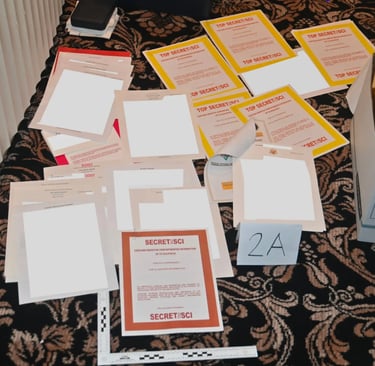
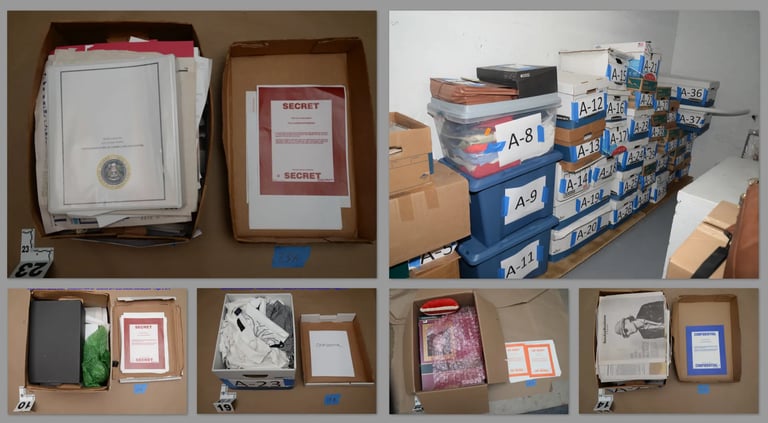
The play opens in the exhausted aftermath of a historic criminal trial involving a former president accused of mishandling classified national security documents and obstructing federal investigators. Twelve jurors enter a sealed deliberation room carrying vastly different political identities, life experiences, and assumptions about truth itself. What begins as a seemingly straightforward review of evidence quickly fractures into a broader argument about institutions, patriotism, media, class resentment, race, religion, and the legitimacy of American power. The first act introduces the jurors not simply as political archetypes, but as wounded citizens shaped by entirely different versions of America.
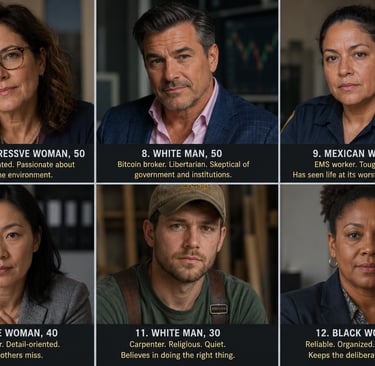
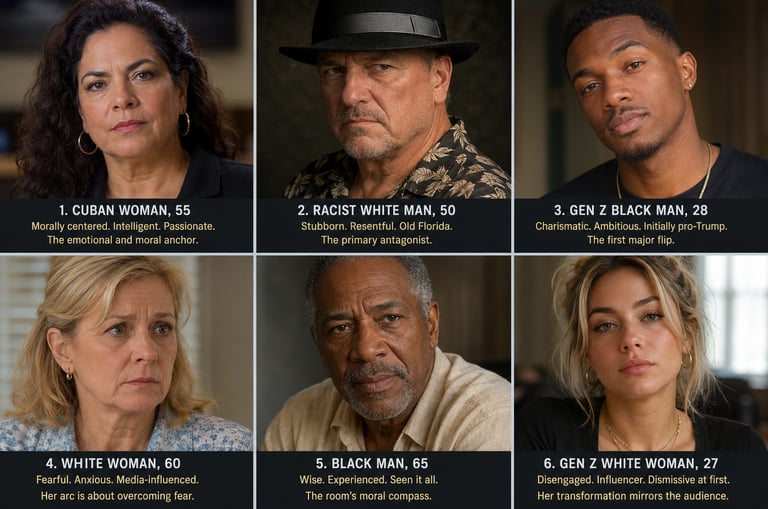
At the center of the conflict is Roy, a working-class populist convinced the prosecution represents a politically weaponized “deep state,” and Atticus, an older juror who still believes civic institutions can survive only if ordinary people defend objective truth. Around them orbit jurors struggling with their own alienation: Ashley, a disengaged social-media native who initially treats the trial like online content; Julius, a volatile and frustrated idealist; Murielle, a spiritually grounded widow trying to hold onto moral clarity; and Mercedes, whose knowledge of federal recordkeeping slowly reveals the extraordinary sensitivity of the documents at issue. By the end of Act I, the room realizes the case is no longer only about one defendant. It is about whether Americans can still reason together at all.
Act II — The Evidence
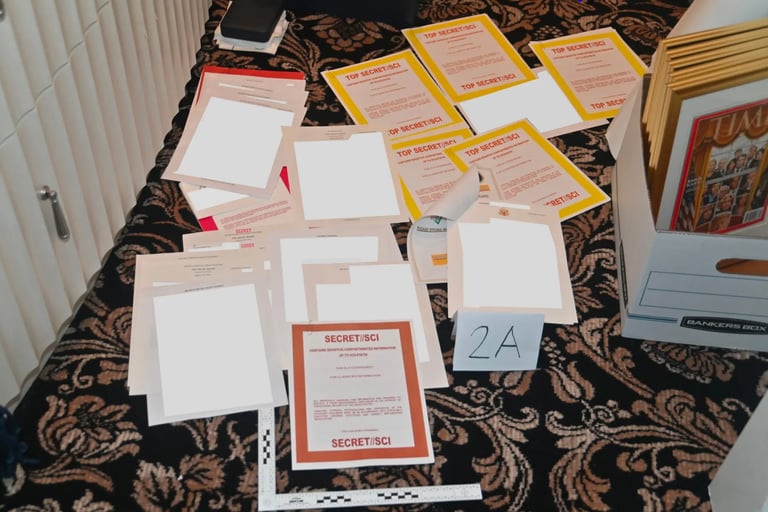
The second act transforms the deliberation room into a civic battlefield. Jurors physically reconstruct timelines, review subpoenas, examine classified document markings, debate witness testimony, and confront the meaning of the Presidential Records Act. As the evidence accumulates, the prosecution’s narrative becomes increasingly difficult to dismiss on factual grounds. Yet rather than bringing consensus, the evidence intensifies emotional division. Roy reframes every exhibit through the lens of betrayal, elite hypocrisy, and institutional distrust rooted in his family’s collapse during the industrial decline of the Midwest.
Meanwhile, other jurors begin changing in unexpected ways. Ashley slowly awakens to the seriousness of democratic responsibility after a lifetime of mediated cynicism. Julius becomes consumed by the fear that truth itself is powerless against tribal loyalty. Atticus attempts to preserve the sanctity of deliberation even as the room deteriorates into accusation and despair. Throughout Act II, the play repeatedly asks whether facts alone can sustain democracy when citizens no longer trust the institutions presenting them. The jury room becomes a microcosm of modern America: fragmented, suspicious, exhausted, but still trapped together.
Act III — The Breaking Point
The final act shifts from political argument into moral crisis. As the jury deadlocks, Julius becomes tempted to secretly record Roy during a recess after suspecting Roy’s resistance is motivated not by genuine doubt, but by the promise of ideological fame and financial reward. The temptation mirrors the very themes of the case itself: surveillance, hidden recordings, secrecy, corruption, and the dangerous belief that procedural norms no longer matter. Atticus intervenes, warning that democracy cannot survive if its defenders abandon their own principles in pursuit of victory.
Roy finally erupts in a devastating monologue about his father losing his livelihood in Flint, Michigan, and his belief that political elites abandoned working Americans long ago. The room begins to understand that Roy is not merely defending one politician; he is defending an identity, a grievance, and a worldview built on decades of distrust. By the end of the play, most jurors converge around the evidence, but Roy remains isolated and immovable. The result is not triumph, but a hung jury — a reflection of a country unable to reach unanimity about truth itself. Yet amid the deadlock, a fragile silver lining emerges: the jurors have listened to one another, confronted one another honestly, and rediscovered a small measure of civic humanity. The verdict may fail, but the room itself survives.



Note to Producers, Directors, Students, & Community Theaters
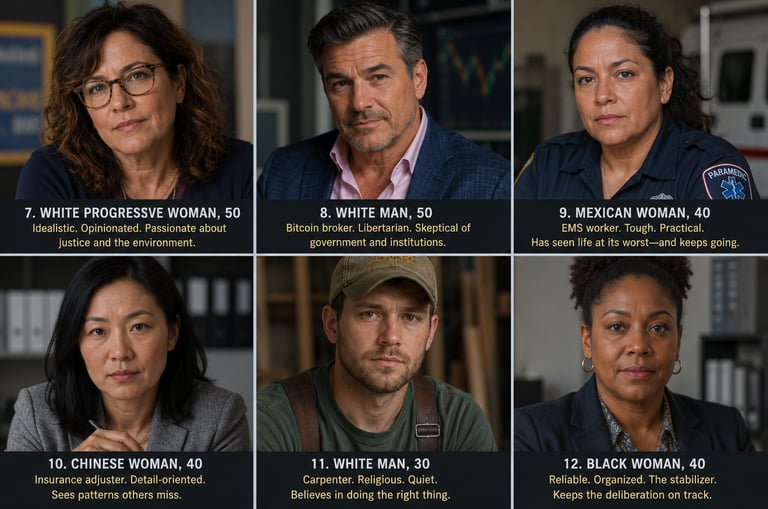
This script is intentionally designed to be flexible, expandable, and adaptable. While the current version reflects one particular cross-section of modern America, producers are strongly encouraged to make the play their own. Change backgrounds, professions, races, ages, religions, genders, accents, political affiliations, or regional identities to reflect the tensions and realities most relevant to your own community. The structure of the play is built around civic collision — not rigid character canon. What matters is assembling six to twelve people who carry genuinely different experiences of America into the same room. From a good storytelling perspective, I would caution against giving too much time to a full panel of twelve jurors. Meaningfully exploring six character arcs in the span of a three-act play is already a stretch. In my version of the script, I chose to hone in on;
The relation of black men (young and old) to the justice system and democracy (exemplified in Atticus and Julius). Black men joining the anti-fascist struggle will be critical to preventing our slide into autocracy.
The immigrant experience and what is and was at stake in 2024, and the xenophobia and grievance politics that drive MAGA. (exemplified in Mercedes and Roy)
The media ecosystem that keeps the young disengaged and the old in fear of the other. (exemplified in Ashley and Murielle)
These were my choices, limiting myself to six "main" characters, but you may have a different focus and a different available cast. Again, make this your own.
The themes explored in 12 Angry Floridians are not limited to one election cycle or one political figure. Productions may wish to deepen certain intersections: immigration, labor, race, religion, rural decline, generational division, military service, disability, media fragmentation, LGBTQ identity, or economic inequality. Some productions may expand the cast with additional jurors, courtroom personnel, projected media, or ensemble voices representing the broader information ecosystem surrounding the trial. Others may strip the production down to its bare essentials: twelve chairs, fluorescent lights, and citizens arguing about the fate of a republic. Both approaches are valid. The goal is not ideological uniformity. The goal is conversation, confrontation, and the preservation of civic theater as a living democratic act.
"Courage is not the absence of fear, but rather the judgment that something else is more important than fear." — Ambrose Redmoon
Legal Concerns: The Judge character serves an important structural purpose within 12 Angry Floridians. In addition to guiding the audience through complex legal and procedural material, the Judge periodically reminds viewers that this work is a fictionalized civic drama inspired by publicly reported events — not a documentary recreation of sealed proceedings or undisclosed testimony. Much of the underlying evidence, witness preparation, jury strategy, and investigative material connected to the real-world case remains unknown to the public, protected by grand jury secrecy, evidentiary rules, sealed filings, or unresolved legal disputes. Producers are encouraged to preserve this framing device if adapting the script, as it reinforces the distinction between dramatic interpretation and factual assertion. Any producer making substantial alterations to character portrayals, factual claims, multimedia elements, or references to real individuals should consult qualified legal counsel regarding defamation, fair use, publicity rights, and other applicable legal considerations before public performance or distribution. Everyone mentioned in the script is a public figure and fair game for critique under your First Amendment right to free speech. This particularly dangerous president has indicted James Comey for posting a picture of seashells spelling out "86 47", and weaponized the Justice Department against his political enemies. Putting on this play is undoubtedly an act of political and moral courage. As I type this and prepare to make this project available to the world, my own risk of political and legal retribution is front-of-mind. Courage.
-Michael Tosner